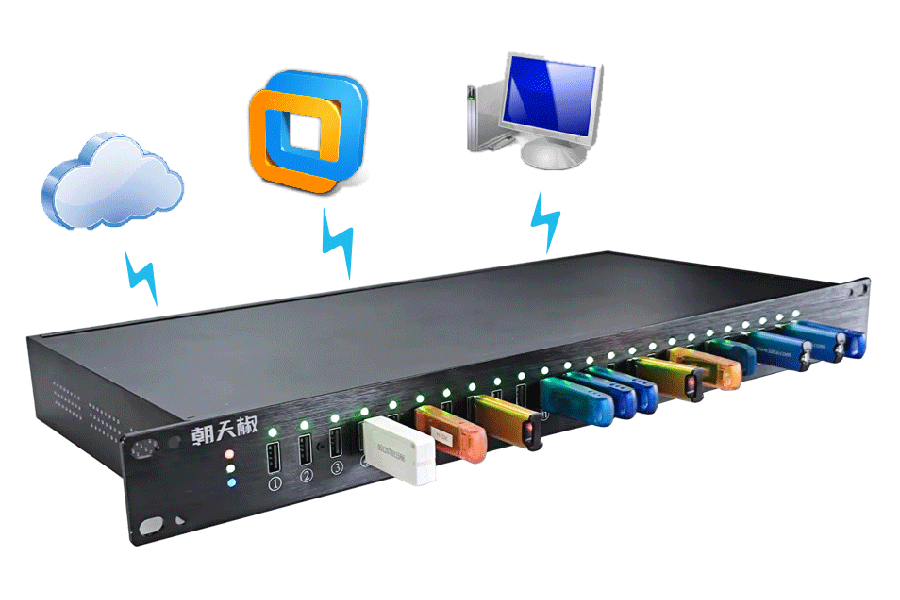
USB over IP is transforming the way people share and control USB devices across modern networks. By transmitting USB signals over standard IP protocols, USB over IP lets printers, scanners, hardware license dongles, and laboratory equipment be accessed as if they were plugged directly into a local machine. A reliable USB Server bridges the gap, presenting each device to remote computers while maintaining the speed and stability of a direct USB cable.
USB Over IP For Remote Access and Virtualization
Virtualization platforms such as VMware, Hyper-V, and Proxmox often struggle with native USB passthrough. USB over IP with a dedicated USB Server overcomes these limitations. Engineering teams can operate test equipment in different time zones, healthcare providers can centralize expensive diagnostic instruments, and creative studios can collaborate on specialized input devices without physically moving hardware. Whether you are connecting across a corporate LAN or through a secure VPN, USB over IP ensures that every USB device is available whenever and wherever it is needed.
USB Over IP Advantages for Modern Networks
A well-designed USB Server brings encrypted connections, granular user permissions, and automatic device recognition to every USB over IP deployment. Scaling is straightforward: plug a new peripheral into the server, and it immediately appears to authorized computers through the USB over IP link. Built-in bandwidth management keeps high-speed peripherals—such as HD cameras, 3D scanners, or industrial controllers—running smoothly even when multiple users share them. Many enterprise-grade solutions also include logging and auditing features, which help IT administrators track device usage and meet compliance requirements.
USB Over IP Use Cases Across Industries
- Product Development: Global teams can access prototypes and specialized hardware through USB over IP, reducing shipping delays and costs.
- Education and Training: Universities can provide remote lab access to students, allowing hands-on experience with instruments via USB over IP from home or satellite campuses.
- Secure Data Handling: Encrypted USB over IP connections protect sensitive medical or financial data during remote sessions.
- Industrial IoT: Factories can integrate sensors and controllers into centralized monitoring systems while retaining USB flexibility.
Implementation Tips and Future Outlook
Deploying USB over IP is straightforward: connect devices to a network-enabled USB Server, install the client software, and select the shared device—it will mount instantly as if attached to a local port. For large organizations, segmenting traffic with VLANs or using a dedicated VPN adds another layer of security.
Looking ahead, USB over IP is likely to play a key role in edge computing and 5G networks, where low latency and distributed processing are critical. As remote and hybrid work models continue to expand, integrating USB over IP with cloud infrastructure will make remote hardware access as seamless as cloud storage is today.
By turning physical peripherals into secure network resources, USB over IP—especially when paired with a robust USB Server—empowers organizations to innovate and collaborate without the traditional limits of distance, cabling, or hardware availability.