
Ethernet Hub in Modern Networks
In the early days of networking, the Ethernet hub was the simplest way to connect multiple devices within a local area network. It allowed computers to communicate, share files, and access printers through a basic data transmission method. However, as technology advanced and businesses demanded more efficient ways to collaborate, the Ethernet hub started to reveal its limitations. Today, the USB server emerges as a superior alternative, offering a more flexible approach to device sharing and remote connectivity.
An Ethernet hub is designed to broadcast incoming data to all connected devices. This simplicity made it easy to set up and inexpensive to deploy, especially in small offices or home networks. Yet this very simplicity also created inefficiencies. The Ethernet hub lacks the intelligence to manage traffic, so every device receives the same data packets, leading to collisions and wasted bandwidth. More importantly, an Ethernet hub cannot handle the sharing of USB devices such as printers, dongles, or laboratory instruments. Its role is restricted to pure network-level data transfer.
Why USB Server Goes Beyond Ethernet Hub
Modern businesses require far more than file sharing. Employees need to access specialized USB equipment across different locations, whether for printing, testing, or software licensing. In this context, Ethernet hub vs USB server becomes a defining comparison. While the hub provides basic connectivity, it is no longer enough for companies that rely on remote access, bandwidth optimization, and device virtualization. This is where the USB server becomes essential.
A USB server fills the gaps left by the Ethernet hub. Instead of only transmitting network packets, the USB server virtualizes USB ports and makes devices available over the network. With this approach, a printer, a hardware dongle, or even industrial machinery connected to a USB server can be accessed as if it were directly attached to a user’s computer. This goes far beyond the limits of an Ethernet hub, enabling true device sharing across distances. Compared to the traditional hub, the USB server offers remote accessibility, better bandwidth management, and compatibility across platforms, making it highly suitable for offices, research labs, and industrial environments.
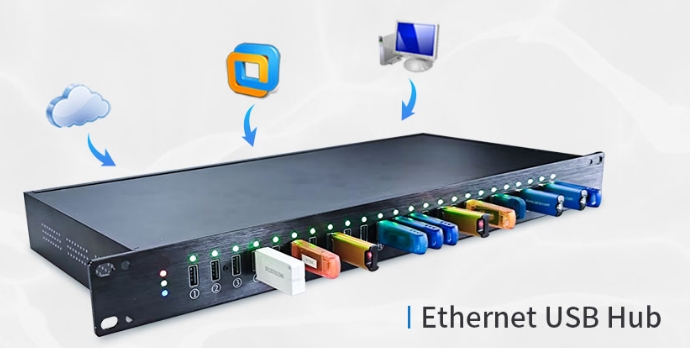
Ethernet Hub vs USB Server in Real Use
The advantages are clear in real-world applications. A design studio can share a USB-based 3D printer without needing everyone in the same office. A research team can run tests on equipment connected hundreds of miles away. Even software protected by a security dongle can be accessed remotely without compromising safety. None of this would be possible through an Ethernet hub, but a USB server makes it seamless by providing USB over Ethernet functionality.
This does not mean the Ethernet hub has become useless. It still plays a role in building simple local connections and providing the foundation for communication. But when combined with a USB server, the network becomes a more powerful ecosystem. The Ethernet hub can maintain basic connectivity, while the USB server adds a higher layer of functionality that enables resource sharing across teams and locations.
The Future of Connectivity
Ultimately, the Ethernet hub was once the cornerstone of local networks, but its limitations are undeniable in a world that demands remote collaboration and smarter resource management. The USB server surpasses the Ethernet hub by enabling remote access, efficient bandwidth usage, and device virtualization. In the debate of Ethernet hub vs USB server, the conclusion is clear: the hub may still have its place in simple setups, but the USB server defines the next generation of connectivity, bridging the gap between traditional data transfer and modern device sharing.
