
In the modern business world, companies need to manage hardware across many locations. Whether you are testing mobile apps or managing security keys, physical distance is a major hurdle. To solve this, the most effective tool available is a professional USB Redirector. This software allows a business to send USB signals over a network to any computer in the world.
However, as a company grows, simple software is not enough to handle dozens of devices at once. This is why forward-thinking enterprises pair their software with a USBManager Server. A USBManager Server is a high-capacity hardware host. It is designed to support massive redirection tasks.
By using a USB Redirector along with a USBManager Server, businesses can create a centralized hardware hub. This combination ensures that your remote clients have stable, high-speed access to every tool they need. Ultimately, the future of enterprise hardware management lies in the perfect marriage between a USB Redirector and dedicated server hardware.
Why Enterprises Need a USB Redirector for Growth
Scaling a business often means adding more hardware. In a local office, this is easy. But when your team is global, moving hardware is slow and expensive. However, a USB Redirector changes the game. It digitizes the connection using USB over IP technology. This makes a physical port available anywhere.
Specifically, the USB Redirector captures the data from a device in your main office. It then streams that data to a laptop in another country. As a result, your engineers can work together without shipping equipment. A developer in London can use a USB Redirector to access a test phone in New York.
Once the USB Redirector is active, the remote computer treats the device as a local one. This is essential for software that needs direct hardware access. Standard cloud sharing often fails to support complex drivers.
But a USB Redirector handles them with ease. Moreover, this technology supports a wide range of devices. From license keys to industrial sensors, a USB Redirector keeps your business moving.
The Power of 16 and 32-Port USBManager Server Units
As an enterprise grows, managing five devices is no longer enough. You might need to manage 16 or 32 ports at the same time. Using many small hubs or old PCs is messy and unstable. This is where a professional USBManager Server becomes a necessity.
A USBManager Server is built to handle high-density hardware. Unlike a home PC, it features an industrial-grade motherboard. This board is designed to support the heavy data traffic generated by a USB Redirector.
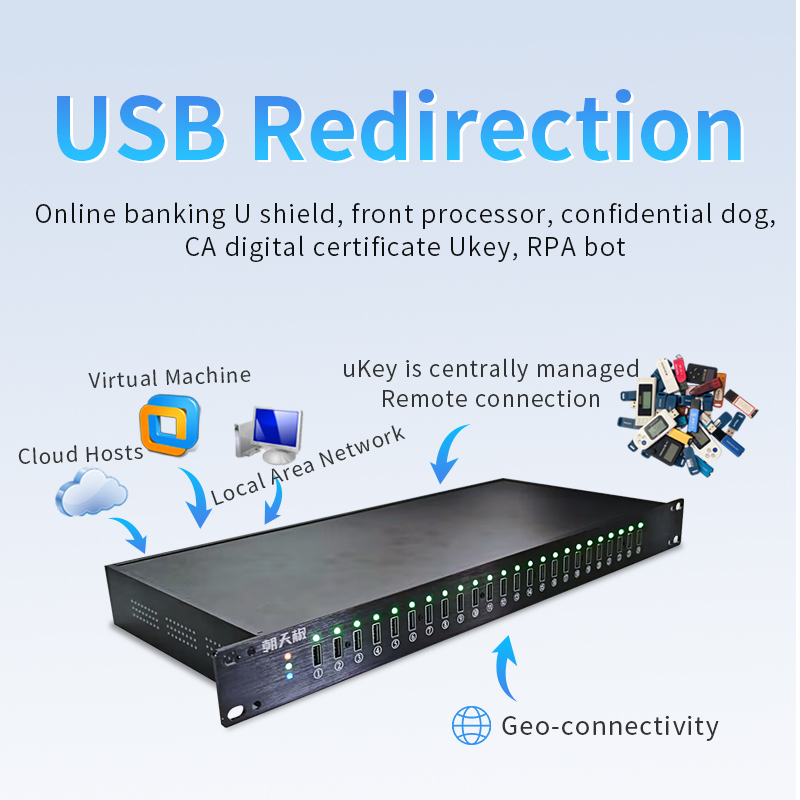
Therefore, a USBManager Server acts as the central heart of your hardware lab. It provides enough power for every port to run at full capacity. For example, if you plug in 32 smartphones, a standard hub would crash. In contrast, a USBManager Server has a massive power supply.
This keeps every device active. This level of power is vital for a USB Redirector setup. If the power drops, the USB Redirector link will break. This causes lost work and frustrated teams. Consequently, the USBManager Server ensures 24/7 uptime for your entire fleet.
Additionally, these servers use Gigabit Ethernet ports. This provides the wide “data pipe” needed for the USB Redirector to transfer files at top speeds. Whether you are doing bulk data backups or remote testing, a dedicated server makes it possible.
Strategic Advantages of a USB Redirector Ecosystem
Investing in a professional USB Redirector infrastructure is a smart move. It allows a company to build a “Private Hardware Cloud.” This brings several major benefits to the business. First, it saves a huge amount of money on shipping.
- Lower Hardware Costs: A USB Redirector lets 100 employees share the same 16-port USBManager Server. You do not need to buy a device for every person.
- Centralized Security: Keep your valuable hardware in one locked room on a USBManager Server. The USB Redirector then provides secure, encrypted access.
- Better Team Agility: When a new project starts, you can assign ports in the USB Redirector dashboard in seconds. You do not have to wait for a courier.
Managing Large-Scale USB Redirector Networks
Managing 32 or 64 ports can be complex. Fortunately, a professional USB Redirector includes a powerful management interface. This dashboard gives an administrator a bird’s-eye view of the whole network.
You can see which ports are active on the USBManager Server at a glance. If a specific port becomes unresponsive, an admin can act quickly. They use the USB Redirector control panel to reset the power to that single port.
This is a unique feature of a USBManager Server. It allows for “per-port power control.” This is impossible on cheap hubs. Because the system is built on professional standards, it is very easy to scale.
If you fill up one 32-port USBManager Server, you can simply add a second one. The USB Redirector software will recognize the new ports immediately. However, for the best performance, you should always use a wired network.
A USB Redirector performs much better on a stable LAN than on Wi-Fi. Thus, it ensures that data transfer remains consistent during heavy use. If you follow these professional steps, your enterprise hardware hub will be a reliable asset for years.
Future-Proofing with USB Redirector Technology
Technology changes fast, but the need for USB connectivity is here to stay. A modern USB Redirector is designed to support the latest standards. By using the software with a USBManager Server, you ensure your company is ready for the future.
Another big challenge for enterprises is virtual machine (VM) support. Many servers in data centers do not have physical USB ports. A USB Redirector is the perfect bridge for this.
It takes a physical device from a USBManager Server and “plugs” it into a virtual machine in the cloud. Rather than using complex workarounds, a USB Redirector provides a direct and clean path.
This is essential for companies running automated tests or secure banking tasks. Consequently, you avoid the compatibility errors that often plague older systems. A professional USB Redirector setup keeps your enterprise flexible and ready for any challenge.
Conclusion
In conclusion, a USB Redirector is the most powerful tool for remote hardware management. It breaks down the walls between global teams. By using the software with a high-capacity USBManager Server, you build a professional system that is built to grow.
Whether you are sharing USB devices across a small studio or a massive global corporation, the USB Redirector gives you the control you need. Instead of struggling with slow tools and messy hubs, invest in a USBManager Server today. Soon, you will see that your hardware setup is faster, safer, and much more efficient.
